

Most photographers start in the same place: a changing bag, a Paterson tank, and a thermometer hovering over a bowl of warm water. That approach works, and for black and white film developed at room temperature it works well enough that many people never look further. But at some point, usually the moment you want to shoot colour, you run into the wall. Holding developer at exactly 38°C throughout a C-41 process, while agitating by hand, while keeping a constant eye on the temperature, is not just demanding. It is the thing that stops a lot of people from ever developing colour film at home at all.
There are three ways to approach home film development. The first is traditional manual development, the foundation everyone starts with. The second is the AGO Film Processor, a genuinely new way of thinking about the temperature problem that makes colour development accessible to every serious film photographer. And at the very top, in a category of its own, are the professional rotary processors used by commercial labs and large-format studios, powerful, precise, and priced accordingly.
Here is an honest look at all three.
Manual Development and Where Everyone Starts
Manual development is the default, and it deserves its reputation as the right place to begin. You mix your chemicals, bring them to temperature, load your developing tank, and agitate by hand, inverting at regular intervals throughout the process. For black and white film, this is genuinely simple. Most B&W developers work at 20°C, which is close enough to room temperature that management is straightforward. A thermometer, a timer, and a bit of practice is all it takes to produce consistent negatives.
The film developing equipment you need to get started is minimal: a developing tank and reel, a changing bag, a thermometer, a few graduates for measuring, and your chemistry. If you would rather not source each piece separately, the Starter Kit for B&W bundles everything into one box, including a Paterson tank, reel, dark bag, thermometer, graduates, storage bottle, film clips, and an ADOX B&W chemical kit. It is a complete home film development setup ready to go from the first roll.
The wall appears when you move to colour. C-41 requires your developer at 38°C for the entire development step, not warm when you pour it in and cooling throughout, but held at temperature throughout. The standard solution is a water bath, a larger container of water kept at temperature with your development tank sitting inside. A more modern version of the same idea is a sous-vide heater, which maintains the bath temperature with more precision and less monitoring. Both approaches work, but both add complexity. You need to pre-heat the bath, monitor it, and manage your tank temperature throughout. A single colour session requires enough setup that many photographers simply decide it is not worth doing at home.
Manual development is the right starting point for anyone learning the process from scratch, anyone primarily shooting black and white, and anyone who wants to understand what is actually happening to their film before automating any part of it. It costs almost nothing to start and teaches everything.
But there is a ceiling, and for colour film, most people hit it.
The AGO Film Processor Is a Genuine Innovation in Analogue
The AGO is a genuine innovation in analogue photography, and understanding what makes it different matters more than it might sound at first.
Traditional development thinking, from manual inversion all the way up to the most professional processors on the market, is built around a single principle. Hold the temperature precisely throughout development. That is why water baths exist. That is why the most advanced professional lab processors use built-in heated water baths with precision electronics, machines engineered to fight temperature drift and win.
The AGO does not fight temperature drift. It accounts for it.
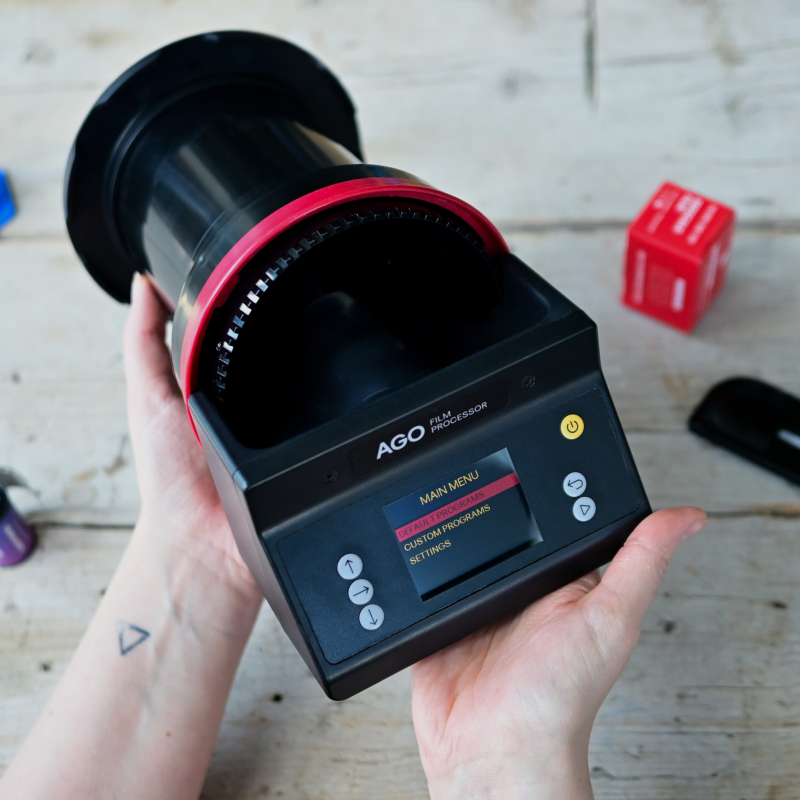
Instead of trying to hold your chemistry at an exact temperature throughout development, the AGO monitors the actual temperature of your chemistry continuously and uses time compensation to adjust the process in real time. You still bring your chemistry to the correct starting temperature before you begin, a quick pre-heat, the same step any development process requires. But from the moment you pour and start the AGO, the machine takes over entirely. Chemistry that cools slightly as development progresses gets a little more time. The AGO calculates the adjustment continuously, so by the time the process is complete, your film has received exactly the right amount of development regardless of how your chemistry temperature behaved along the way.
This is not a workaround. It is a more intelligent model of what development actually is. A chemical reaction whose rate is predictably tied to temperature. The AGO works with that relationship rather than trying to override it, and that shift in thinking is what makes it a true innovation rather than just another piece of darkroom equipment.
In practice, this means that C-41 colour film development at home stops being a plumbing exercise. You pre-heat your chemistry, pour it in, start the processor, and walk away. No thermometer to watch. No anxiety about whether your developer dropped half a degree between agitation intervals. C-41, which has historically been the format most likely to discourage home development, becomes routine. E-6 slide film, which demands even tighter tolerances and has always been considered firmly out of reach for most home developers, becomes genuinely approachable.
Continuous horizontal rotation handles agitation evenly and without fatigue for the full duration of development. The AGO works with standard Paterson tanks in 1-reel and 2-reel configurations, which means most photographers can start using it without buying anything new. It fits on a kitchen counter and packs away when you are done.
97% of AGO owners surveyed said they would buy it again. That number holds across every type of shooter, from beginners doing their first C-41 roll to experienced photographers processing large volumes every week, and everyone in the wide, well-populated middle.
Designed to fit your workflow, not replace it
Works with standard Paterson tanks. Handles B&W, C-41, E-6, ECN-2, and RA-4. Automatic temperature compensation, continuous rotary agitation, WiFi-updated chemistry profiles. €439 / ~$480 USD.
See the AGO Film ProcessorProfessional Lab Processors Are a Different Category Entirely
At the top of the food chain sit a small number of professional rotary processors built for commercial labs, large-format studios, and darkrooms running at serious scale. These machines handle everything from 35mm up through 4x5, 5x7, 8x10, and beyond, plus large paper prints. They feature built-in heated water baths with precision electronic temperature control, programmable process timers, and cold-water solenoid inlets for active cooling. They are, in every meaningful sense, pieces of lab infrastructure.
The capability is remarkable. For a professional photographer running a dedicated studio and processing large-format sheet film every day, or for a community darkroom serving dozens of members, a machine at this level earns its place. But that capability comes with everything that lab infrastructure implies. A price starting around €3,500–4,000 for the processor alone, before tanks, drums, or accessories, all of which are proprietary to the system and not interchangeable with the Paterson tanks most photographers already own. And a fixed, dedicated footprint. These are not machines you move around or store between sessions.
For a home photographer, even a very serious one processing twenty rolls a week, a professional lab processor is a machine whose capabilities extend far beyond anything an individual shooting process requires. The total investment, the space commitment, and the proprietary ecosystem are all sized for a different context entirely.
How They Compare
| Manual | AGO Film Processor | Professional Lab Processors | |
|---|---|---|---|
| Price | ~€50–100 (tank + basics) | €439 / ~$480 USD | €3,500–4,000+ system |
| Temperature approach | Manual monitoring | Intelligent time compensation | Heated water bath + precision electronics |
| Agitation | Hand inversion | Continuous rotation | Continuous rotation |
| Water bath required | Yes, for colour (or sous-vide) | No, pre-heat chemistry and AGO handles the rest | Built-in |
| Colour film (C-41) | Possible with effort | Seamless | Seamless |
| E-6 slide film | Very difficult | Accessible | Professional-grade |
| Large format support | 35mm, 120 | 35mm, 120, 4×5, 5×7, 8×10, prints up to 40×30cm | All formats + 11×14 and larger |
| Tank compatibility | Standard Paterson | Standard Paterson, designed for it | Proprietary tanks only |
| Space required | Small | Counter space only | Dedicated, permanent |
| Who it's for | Anyone learning | Every film photographer, hobby to professional | Commercial labs and large-format studios |
Who the AGO Is For
The honest answer is most film photographers. Not as a compromise, but as the right tool for the full range of people who develop film seriously.
At €439 (around $480 USD), the AGO starts making financial sense from roughly 3 to 4 rolls a month. Below that volume, you will likely come out ahead sending film to a lab in pure cost terms. But cost is only part of the picture. Developing your own film is one of the most satisfying parts of shooting analogue, and the connection you get from handling every step of the process yourself, from exposure to negative, is something a lab drop-off simply cannot give you. If that matters to you, the AGO pays for itself in ways a spreadsheet will not capture.
If you are shooting 35mm or 120, colour or black and white, a handful of rolls a month or a high volume every week, the AGO covers every process you will ever need to run. High-volume shooters developing ten, twenty, or more rolls a month find that continuous rotation and automatic time compensation deliver results that are consistent roll to roll in a way that hand inversion at varying room temperatures simply cannot match. When you are processing a full run of C-41 on a Saturday afternoon, not having to babysit each tank changes the nature of the whole session.
If you have been developing black and white for a while and want to add colour, the AGO is the most practical route there is. You do not need to set up a water bath. You do not need a sous-vide heater. You pre-heat your chemistry, load your reels, and start the processor. The ongoing temperature management, the part that makes C-41 feel like too much work, is handled automatically from the moment you press start. The transition from B&W film development to C-41 stops being a project and becomes another Saturday morning.
If you shoot large format up to 8x10 or want to process prints up to 40x30cm, the AGO's format support goes further than most people expect. It handles 4x5, 5x7, and 8x10 film as well as optical prints, giving serious photographers the processing range they need without stepping into the territory of professional lab equipment.
If you are returning to film after a break, the AGO is designed for exactly this scenario. Photographers coming back after years away consistently say the same thing. The AGO removes the part of colour development that was always the most demanding. Loading reels is still hands-on. Mixing chemistry is still hands-on. But the temperature management that once required water baths, thermometers, and constant monitoring is handled intelligently and automatically. Everything that was tedious about colour development before is simply gone.
If you are running a small studio, a community darkroom, or a shared space where multiple photographers develop film, the AGO's consistency and low setup overhead make it a practical workhorse that produces the same results whoever is using it.
If you are working in a small space with no room for a permanently installed water bath setup, the AGO's counter-sized footprint and pack-away design make home colour development possible where it was not before.
The only photographers who genuinely need to look beyond the AGO are those processing large-format sheet film at professional lab volume, 4x5 and larger in very high quantities, or printing at scales above 40x30cm. For everyone else, the AGO is not a stepping stone to something better. It is the right answer.
The 97% repurchase rate is not a number that happens by accident. It comes from the AGO solving the right problem in a way that actually fits into a photographer's life, not into an imagined dedicated darkroom, but into a kitchen, a bathroom, a corner of an apartment.
Getting Started with Home Film Development
Whatever approach you choose, the foundation is the same: a developing tank, reels, a changing bag or changing tent, and the right chemistry for your film type.
For black and white, the fastest way to go from zero to developing your first roll is the Starter Kit for B&W, which includes every piece of film developing equipment you need in a single box. If you already own a tank and reel, Kodak D-76, Ilford ID-11, and Kodak HC-110 are reliable developer choices. For C-41 colour negative film, kits from Cinestill or Tetenal include everything you need in the right quantities. E-6 chemistry is more involved, with multiple steps and tight tolerances, but with the AGO's time compensation handling the temperature variable, the process is genuinely manageable.
The AGO Film Processor works with standard Paterson tanks in 1-reel and 2-reel configurations, which most photographers already own. There is no proprietary tank system to buy into.
For a complete walkthrough of the process, start with our complete guide to developing film at home.
Common Questions
Is manual development good enough for colour film?
It can work, but it requires a water bath or sous-vide setup to hold developer at 38°C throughout, plus careful attention during the process. With the AGO, you pre-heat your chemistry to the right starting temperature and the machine handles everything from there. No water bath, no monitoring, no stress.
Does the AGO work with my Paterson tank?
Yes. The AGO was designed specifically for standard Paterson tanks. You will not need to buy anything new to use it.
Is the AGO worth it if I only shoot a few rolls a month?
From around 3 to 4 rolls a month, the AGO makes strong financial sense. Below that, a lab is likely cheaper in pure cost terms. But developing your own film is about more than cost. The connection to your own process, handling your negatives from exposure to development yourself, is something a lab cannot give you. Many photographers with that volume find the AGO well worth it for exactly that reason.
Can I develop E-6 slide film at home?
Yes, and the AGO makes it more accessible than it has ever been. E-6 is demanding precisely because of its temperature requirements. The AGO's time compensation approach handles that throughout the entire process.
What formats does the AGO support?
35mm, 120, 4x5, 5x7, and 8x10 film, plus optical darkroom prints up to 40x30cm. The AGO covers the full range of formats that home and studio photographers work with.
What do I need to start developing black and white film?
At minimum, a developing tank, reel, changing bag, thermometer, graduates, and B&W chemistry. The Starter Kit for B&W includes all of this in one package for €135, so you can develop your first roll straight out of the box.
Who develops film at professional level and needs more than the AGO?
Photographers processing large-format sheet film at very high commercial volumes, think a lab running hundreds of sheets per week, or printing above 40x30cm may need the dedicated infrastructure of a professional lab processor. For everyone else, the AGO covers everything.